Monday, August 23, 2010

Happy Surprises... Petrocosmea 'Keystone's Whipporwill'

Every day brings a surprise for the grower and hybridizer of plants. Since the cultivation and hybridization of Petrocosmea is still in it's infancy, I'm finding this genus, my favorite gesneriad genus, especially thrilling. If you have never tried hybridizing, you really must. I promise you that if I can figure it out, anyone can. I have no training in this stuff....I just started with an interest, then a fascination, then, some might argue, an obsession. I read everything I could find on the genus, (and I could find very little to read, let me assure you.) But, mostly, I observed my plants, and tried, and failed, and tried again, and failed again (repeat this ten more times....). Then finally one day, it worked! So, pick a favorite gesneriad or two (I guess to hybridize one would need at least two...)...and try it! You'll be in for an incredible journey!

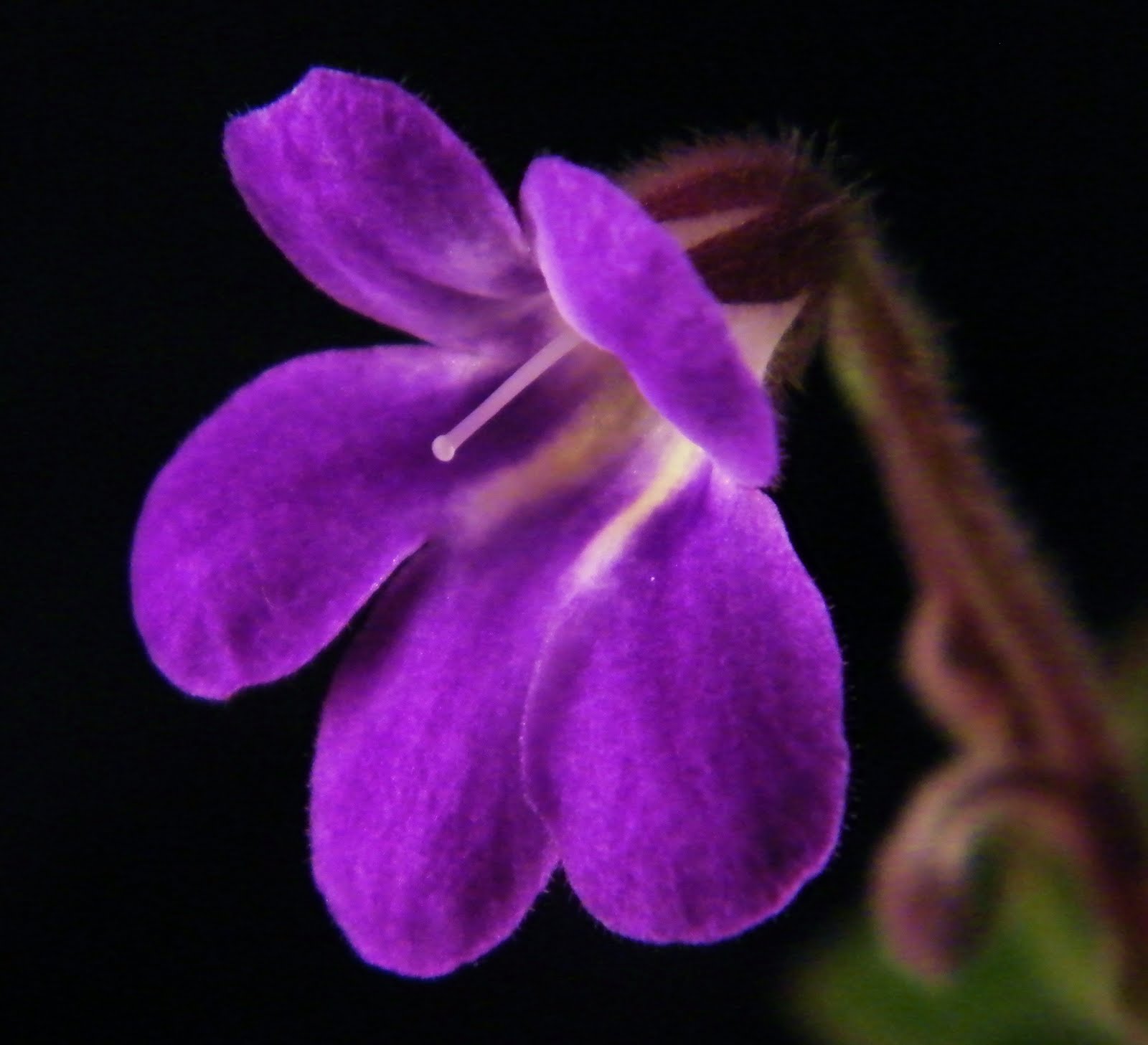
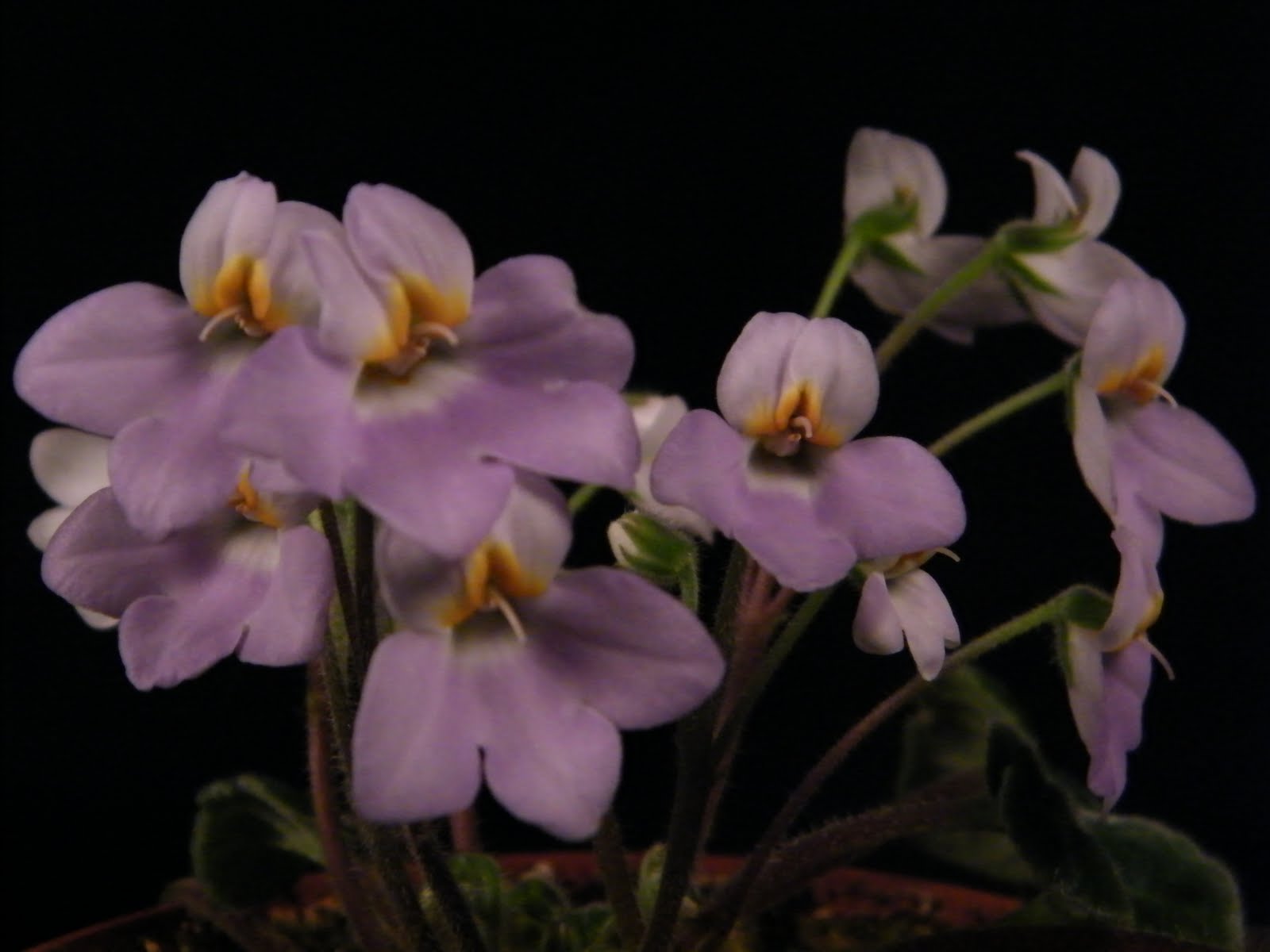
So, what was today's surprise? Well, my hybrid from last year, is flowering again, only five months after it's first flowering...and it is flowering in the summer! Why am I excited about this? Well, for one thing, it shows great promise of having a Petrocosmea that will flower more than once annually....it extends the number of days in a year when the plant will be in flower! And, it extends the flowering season into the summer months...a time when, for most of us, our Petrocosmea plants are not in flower. The hybrid, pictured above, is P. 'Keystone's Whipporwill'. The parentage is P.' Asa Blue' x begoniifolia.
P. 'Keystone's Whipporwill' in its second bloom.... gets better with age. The original plant, pictured above, is growing in a three inch diameter, one inch deep condiment cup...the type used in restaurants to serve sauces, etc. The center leaves are tight and puckered due to my choice to switch my fluorescent lights to T8 bulbs about three months ago...resulting in a great deal more light...many of the Pets don't care for it. I will be reducing the hours/day that the lights are on to make the plants happier. But, other than that, the plant has performed well. It grows easily, has not suckered, so far, and has attractive deep green foliage with a bronzy/purple cast and underside. Foliage is reminiscent of the P. begoniifolia parent, but more heart shaped, and a bit softer, like the P. 'Asa Blue' parent. P. 'Asa Blue' is a remake of the cross which produced 'Momo'...P. nervosa x flaccida. It flowers several times a year, and has a high flower count. This cross marked the first success at using a Petrocosmea hybrid as a parent. So these hybrids have three species in the background.
With maturity, the pedicels are producing three to five flowers each, on the average. Prior to taking the photo, I removed six spent blossoms. There are still lots of buds coming underneath the leaves. This promises to increase the bloom count and extend the flowering season.

The lighting in the photo doesn't clearly show the attractive bright yellow stripes in the throat of the flowers...but they are there. The blue in the photo is pretty accurate. Flowers have the shape of the begoniifolia parent, and this is also where the yellow comes from. Flowers are larger than either parent too. Plant size seems compact so far.


Another characteristic that I selected P. 'Keystone's Whipporwill' for was the attractive purple flower stems and calyces. I felt that since most Petrocosmea stems and calyces are green, this added another pleasing characteristic to the hybrid. I have distributed a few leaves to close friends for testing. Now, with further evaluation, I will begin to distribute the plant more widely...guess I'd better put some leaves down for myself too...for insurance. More than two years in the works, I'm happy with the result and consider the effort well worth it!


Sunday, August 22, 2010

Bigfoot....Story of a Big and Furry seedling!

I have trouble even calling this baby a seedling...it's so big! The picture above shows a great example of the agonies of hybridizing....waiting to see a new seedlings full potential before deciding to keep it or cull it. Sure it's a nice plant...even a nice Petrocosmea...but I'm trying to hybridize for more than a "nice" Petrocosmea...we already have plenty of those designed by Mother Nature in the form of the various species.... At around nine inches in diameter...yes nine inches in diameter, its an impressive green plant. The result of a cross between the compact and happy little species P. forrestii, which was it's mother, and the much larger and bolder P. duclouxii (or grandiflora, depending on whose opinion you favor). It gets it's form from its mom. To look at the photo and not know the plant size, one could easily assume it was a photo of a non-flowering P. forrestii...but this guy is BIG!!! Larger, even, than it's father..P. duclouxii.


Note the furry leaves...the long silvery hairs on this plant clearly came from P. duclouxii. They are soft and silky and enhance the plant's appearance and appeal. This seedling has two named siblings...P. 'Keystone's Little Rascal' and P. 'Keystone's Angora'. ..(both of which are pictured in previous posts on the blog). It did bloom, last year. Flowers were very similar in color and size to it's P. duclouxii parent. The flower count for a first bloom seedling was very good. My records show that it produced 22 flowers over the first bloom season. The bloom season was from late January through the end of March...so it had an acceptable flowering period.
So why am I hesitant to name it? My hesitation is from two concerns....1) was it different enough from P. 'Keystone's Angora' and 2) the flower pedicels were long...much like P. forrestii. The pedicels appeared wiry and didn't hold the flowers upright at the best attitude. They did support the flowers..they didn't flop, it was just that when I looked at them...they didn't look back at me as nicely as I would have hoped. The flowers were quite large...larger than either of it's two siblings, which was a plus. The lobes, however, were sort of pointed more like the forrestii parent and I felt the rounder lobes of 'Keystone's Angora' were more attractive. The flowers on this one were more "star-like" and pointier in appearance.
So, another year of growth has shown that this seedling is different in several promising ways, and it is surely larger than it's two siblings. It shapes up nicely, and makes an attractive rosette. Lets just see what the next flowering season produces. And, of course, we'll see if it produces suckers...so far, none of the selections in this cross have done so. (I select against offset or sucker production in my hybrids, as I feel it detracts from the nice, smooth, flat rosette. The plants root easily from leaf cuttings, so I feel the suckers are not needed.)

Saturday, August 14, 2010

"The Wait..." New Petrocosmea Hybrid Seedlings

The miserably hot weather we've been having is not "a favorite" with my Petrocosmeas. While they much prefer the cooler temperatures of autumn and winter, the humidity that comes along with the warm temperatures does provide some comfort. As the days get hotter, I lower the number of hours that my lights are on and increase the air movement in the basement growing area. The mature plants seem to just stand still, in suspended animation, while the little seedlings actually chug along, growing at quite a rapid pace.

A few species are in bloom....P. barbata, P. begoniifolia, and even P. nervosa and P. sp. 'vittatae' are blooming. The hybrids, P. 'Asa Blue' and 'Short'nin' Bread' are also in flower now. To test my theory that successful seed set only occurs in cold temperatures, I tried to self all of the above and got nothing. I tried crossing several of them also...and got one enlarging seedpod on nervosa, for a month, then it died. They just seemed to laugh at me and my folly of asking them to do something that I was pretty sure they were not about to do....and they didn't! I have tested pollination in warmer temperatures for two summers now without success. Last year I did get three mature seedpods on P. begoniifolia, but when I opened the dried seedpods, there was not a single seed to be found. I even examined them under a microscope...no seeds. In winter, with cold temperatures, I have much greater success with seed formation.

I mentioned the hybrid seedlings. This summer I am watching a number of exciting new crosses coming along. My favorite, so far, this year, is a cross between P. forrestii and P. minor smooth leaf form. This is only the third hybrid that I have been able to produce from P. minor. The plants are making lovely deep green rosettes, similar in size and appearance to P. forrestii, but with a deep green glossiness to the leaves that is definitely P. minor!!! One seedling in particular has leaves that are very glossy.


A trio of seedlings from a cross between P. forrestii and the smooth leaf form of P. minor. The seedling in the lower portion of the photo is much glossier than it's siblings and a bit deeper green in color. From among a tray of a dozen seedlings, this one has stood out from the very early stages for the glossiness of the leaves. Note the slightly different leaf shapes and the differences in the leaf veining. The seedling in the upper right has leaves that are nearly perfectly round, like minor..... while the other two seedlings have a bit more of a point at the tip of the leaf...more like forrestii.


"The One To Watch" at least from the standpoint of foliage. This seedling of P. forrestii x P. minor smooth leaf form has leaves that are significantly glossier and shinier than it's siblings. I'm talking to this little guy every day now! The seedling in the photo is now four inches in diameter.

Wednesday, July 7, 2010

Back at work.....

Greetings! One never knows what life is going to toss at us. The last couple of months have been a bit tough with an unexpected illness and surgery. Three hospital stays and a few weeks to recover and everything is fine now...things seem back on track. The past couple of weeks have seen me able to get back among the beloved Petrocosmeas....I've missed them~! But, as they always do, they banished my duldrums with the annual start of the flowering season. The earliest to bloom for me, P. formosa, was in all of her glory when I made my first visit back to the basement plantroom. What a welcome!


While P. formosa most typically blooms in pale orchid purple, a fellow Petrocosmea enthusiast in New York gave me a peek at his white P. formosa. Not sure where he acquired the plant, he did not recall it being given to him as a white form...however, that's what it has produced for the past couple of seasons now. He observes that the flowers remain pure white with the typical yellow base to the upper corolla lobes. I did note, that the yellow blotch in this form is more lemon yellow whereas the yellow blotch in the typical purple form that I grow is more orange-yellow. I have a large leaf form and a small leaf form and both produce purple flowers with orange-yellow blotches. I'm hoping this one remains white.... a lovely flower it was indeed!

Getting back to the Petrocosmeas just as they are producing this years flush of growth made me restless to get things groomed, repotted and "back in order". This photo shows an assortment of species Petrocosmeas in the matt-lined trays in which I grow them. The larger plants in the foreground are in 5 inch pan pots and are a couple of years old now. They were groomed of old outer leaves, the top quarter inch or so of soil was gently washed away and they were top dressed with systemic insecticide granules and fresh soil mix. The mats were washed in hot water, detergent and bleach and repositioned in the bottom of the trays, where they were dampened to provide humidity. These mats are cheap acrylic blankets cut into 22x22" sections, folded once to make a double thickness to line the 11x22" nursery trays. As the plants come into bud in the fall, the trays are covered with a plastic humidity dome to increase the humidity for the flowers....which aids is successfull pollination when I hybridize them. Last the plants were watered in with dilute fertilize water. And, for good measure, I told them how beautiful they were and encouraged them to grow up to be big and strong....

I've often been asked "How do you find new Petrocosmeas?" Admittedly, they can be a challenge to find. I am very fortunate to have great plant friends who know my love for the genus, and when the acquire new selections, the share them with me. The box above was a generous gift from a dear Canadian friend who brought them across the border to me last March when I attended the Buffalo, New York gesneriad and violet show. The included a new unidentified species labeled P. sp. 'Chinese #3' and a new form of P. rosettifolia with nice bluish lavendar flowers...(this made my fifth form of P. rosettifolia...all distinctly different from each other, but all clearly, the same species.....of course DNA analysis helped me to prove that!) How exciting to have five forms of the same Petrocosmea species! So, my advice to those wanting to build a collection is to get the word out to all of your plant friends......Gesneriad lovers are among the most generous people in the world!
Once home, I dutifully put down leaves from each of the new Petrocosmeas in the box above, partly as insurance again loss, and partly to be able to distribute them to others. That is one of the best nuggets of advice I ever got from a wise gesneriad grower.....Whenver acquiring a new gesneriad...PROPAGATE IT!!! That has saved me from losing a precious new acquisition so many times!
It feels good to be back. I'll do my best to post to the blog more often now!


Tuesday, May 25, 2010

Bloom Potential for Petrocosmea and "How Do I Get Them To Bloom?"

What can we expect from a Petrocosmea when it flowers? How much bloom is the plant capable of? When we look at a Petrocosmea entered in a flower show in bloom, how do we assess if the plant is meeting it's potential for bloom? As an admirer of this fascinating genus, and as both and exhibitor and Master judge for the Gesneriad Society, I am often faced with these questions. When I give a presentation on Petrocosmea, I am often asked how to "make them bloom". So for the past couple of years, I've done a bit of personal research and study on my own plants to assess just what it takes to get the plants to bloom at their full potential. I thought I would share my findings and thoughts with you here.


The plant in the photograph above is Petrocosmea grandiflora (or duclouxii, or floribunda...depending upon the source you obtained your plant from...genetically, they are all turning out to be the same species). This plant is my own plant, and the photo was taken this past January, as one all five of my mature plants of this species came into flower. This one is typical of those that I grew in the basement, in rather cold conditions, with humidity between 45 and 70%. The plant is in a 5" pan pot, where it has now been for four years. I have only top dressed the plant with new soil...it has not been repotted in that time. Starting in August, this plant was given plain water, only watered about once a month, and kept rather dry in between these monthly waterings. At times, the soil dried to the point that the leaves wilted a bit. Temperatures in December and January were as low as 35 degrees F and and as high as 52 degrees F. This is it's bloom potential under these conditions. Other plants of this same species, of the same age, in the same potting mix and pot size, that were kept warmer, and given more frequent waterings, (one was wicked on a reservior of dilute fertilizer water) all flowered significantly less than this one. The plant on the reserviour of water had less than half as many flowers, but did have more leaves on the rosette.


So this is what I got with the cold, dry, humid, and no fertilizer treatment described above. Other species given identical treatment all flowered heavily. They are pictured below.....


Petrocosmea minor smooth leaf form was also kept cold, dry and humid. This is the most this plant has ever flowered for me in several years. This species does not appear to flower heavily at one time, but instead seems to flower over a longer period of time, with a few flowers open at one time. This plant is also in a 5" pot and has been there for three years now without repotting.


The above photo is a showplant, a first place winner, grown by the master gesneriad grower Bev Williams of Canada. Her plants are always grown and shown at full potential. The plant is a lavendar flowered from of Petrocosmea rosettifolia. This species always seems to put flowers out along the outer edge of the rosette, rather than clustering the flowers toward the center of the rosette as some species do. Note the flowers here....when entered in bloom, this is what an exhibitor or judge of Petrocosmea should consider in deciding on the points value of "Quantity of Bloom". Many Petrocosmeas entered into shows here in the USA in flower are in my opinion, entered as either immature plants or they have been grown in such a manner that full bloom potential is not acheived. Often Pets in shows have four or five flowers and they score pretty high on the "Quantity of Bloom" section of the score sheet. This is something that judges should begin to consider and "adjust" when the evaluate Petrocosmeas entered in bloom.....again, just my opinion........


A mature but rather small plant of Petrocosmea sp. 'China 2005' in it's third year in a 3 1/2" pot. This plant was also given the cold, dry, humid, plain water treatment described above, and flowered much better this year than ever before. This plant stays much smaller at maturity than other species, so I grow it in a smaller pot. It's bloom potential makes it a great candidate for hybridizing with the goal of producing hybrids with more bloom potential. Cold and dry seems to to the trick with this one too!


A blooming plant of Petrocosmea sp. 'Yumebutai'. I've only had this plant for three years, and it has remained in a 4" pot since I got it...never repotted. When this plant was given to me, the grower said that he'd never been able to flower it. I've also heard this about this species from one other grower. The plant did not flower for me last year, when it was grown warmer and watered more often. But, this year, the cold, dry, and humid treatment worked well. This photo was taken in early February of this year.


SO, what factors worked best for me? Well, the cold is definitely a positive factor in at least increasing the flower count. I've heard from a correspondent in China, who has seen Pets growing in habitat many times, that the plants often experience short periods where they are covered with snow. My basement gets down to the mid-30's F range. Now, I realize that most growers who grow in the living areas of their homes cannot allow the temperatures to get down into the 30's.... but I'm just saying that it definitely helped in my research. Yes, plants in the warmer areas did flower...just not nearly as much as those in the basement where it was cold.


Secondly, plain water helped. The rationale I used for this is that fertilizers might be forcing more foliage growth at the expense of flower buds. Maybe so, or maybe not. But that was a factor in my experiment and those plants did seem to have more flowers and smaller rosettes. I began with the plain water when the plants were beginning to form buds.


Third, high humidity. I feel this helps the buds to mature and not to blast. In the warmer areas, with more heat, the humidity was lower. I occasionally did see a loss of some flower buds in that situation. But, then I advocate high humidity for Petrocosmeas all year long. Why, because my plants with higher humidity look better, grow better, flower better and set seeds better than those with lower humidity. That's good enough for me!


Fourth, infrequent repotting. I won't go so far as to say that Petrocosmeas resent repotting. I've never had a Petrocosmea show any apparent negative effects of repotting. I'm just saying that I don't think it is necessary. I get great results by leaving them along. As long as the mix is draining well and not washed away, my Pets seem very happy staying where they are. Also, I'm not aware of anyone or anything in nature that repots the Petrocosmeas in the mountains of China? Are you?


Last, maturity. By that I mean that I now feel that it takes three or four years of growth for a newly propagated Petrocosmea to reach it's full potential. My plants clearly perform better with each year of life they have...my older Pets perform the best every time! So, again, when considering a show plant....is it mature? This can be difficult to tell since the grower may have kept the plant smaller intentionally, and should therefore not be faulted for choosing to do so. However, bulk seems to improve performance....perhaps the larger root mass and foliar mass support more flower production?


So there you have the results of what I am seeing as I study these plants more closely over the past few years. I hope these observations will help those who are struggling with getting their Pets to bloom......and judges!!!.....consider bloom potential when awarding a Petrocosmea entered in bloom.


Saturday, May 1, 2010

"The Experiment" - Growing Pets Outdoors

Having grown Petrocosmeas in just about every fashion possible INDOORS, I had to try growing them outdoors. Here's my story...........
I'm not sure if the problem was having too much time on my hands or having too many Petrocosmeas on hand, but the thought occured to me, and I just had to do it! Actually, I'm certain it wasn't the former, because there never seems to be enough time in the day.... Nonetheless, I'm now well on my way with an experiment in growing Petrocosmea outdoors in southwestern Pennsylvania. Pittsburgh is in USDA zone 6, and my outdoor growing space is pretty cool and shady. Our summer temperatures here are relatively mild, with lots of rain. As I thought about it, I realized that our climate here is pretty close to what I've read about the natural environment where many Petrocosmea species grow in China, so I figured...."why not?"
So, here's what I've done. First, I selected the plants I wanted to use a couple of weeks ago, and let them dry out to the point of being limp....I did this in order to avoid breaking leaves off of brittle, turgid plants. Then, I took an old terracotta "strawberry jar", (I've had this thing forever!!!) and filled it with a loose, but fertile soil mix that included lots of humus and a little composted manure. I selected a collection of species that offered variety. And, having groomed more than my fair share of dirty Pet leaves, I decided to fill the jar and start to pot from the top, in order to avoid soil from above falling onto the leaves of the plants below. This is backward from the way I would normally pot up a strawberry jar, but for the Pets, it worked flawlessly. And, since Petrocosmeas are "rock plants" I had to include a large rock on the top for some ornamentation and interest. The Pet species I used were : minor veined leaf form, rosettifolia forms #2, and #3, barbata, forrestii, begoniifolia, nervosa, and kerrii. I mulched any exposed soil with small gravel and watered them in with a vitamin root stimulant diluted in water. They will remain in total shade and I sited them so that they will get good air movement. Luckily the spot is also along the path I take into and out of the house each day as I go to work, so I can see my beloved Pets at the start and end of my dayI!

I'll let you know how the experiment progresses!

Wednesday, March 31, 2010

A Few More Baby Pictures.....

Well, you know how it is with proud parents and pictures of the "kids"...... I found a few more photos from the same P. 'Asa Blue' x begoniifolia cross. The photo above shows a large flower, very full petals, a pinkish coloration and some ruffling in the petals. The slight yellow marks in the throat are still there, and this one has some spotting in the throat. The peduncles on this seedling were also nice and compact, which helped to support the large flowers. This one was also kept for further evaluation. (Sorry that the photo is not in focus.)
This photo shows the flower from the first photo, beside of a sibling which has the more typical flower shape for the cross. I took this photo to show the difference in the roundness and fullness of the petals. The leaves also has a nice purple border, which came from the begoniifolia parent. P. begoniifolia is the only Pet that I've seen that has burgundy red underside to the leaves.

The first seedling to flower....... Wow, was it a surprise and was it different! It has ruffled petals, extra petals, yellow and green in the throat, and white splashed all through the petals. It kept these characteristics in the subsequent flowers to open....but was not as floriferous as I had hoped...I have kept it for further testing...hoping that with maturity, it will prove to be more floriferous.


And one that I kept calling 'Froggy' since it has an odd shape, and lots of green in the flowers..... This flower has four colors...green, white, yellow and purple! Of course, I kept this one to test further too......


Finally, as shot showing the foliage from a seedling...this plant, 'Keystone's Belmont' (photo of flowers in the previous post), was awarded 96 points in the New Gesneriads class at the recent show in Bufflalo. It won a second place ribbon in competitive judging, nudged out of first place by my other Pet. hybrid 'Keystone's Bluejay'. This hybrid shows a bit more of the P. flaccida grandparent in it's ancestry...which is one of the parents of P. 'Asa Blue'...it's mother.
I've been quite happy with the results of this cross. The variation has been stupendous and I am anxious to see the seedlings which I have selected as they flower in the second season this fall.